7 Pickleball Drills to Do With a Partner, Plus a One-Hour Session Plan
Two players, one court, an hour. Seven drills that build the shots games are won with, and how to fit them into a single practice.
InstaPickleball · · 6 min read
Most players get better by playing more games. That works until it doesn't: in a game you hit each shot a handful of times, always under pressure, and never get to try it again right away. A drill gives you the same shot twenty times in a row, so you can feel what changed between a good one and a bad one.
All you need is one other player, a court and a bag of balls. Some ground rules make every drill below work better:
- Cooperate first. Start each drill trying to keep the ball in play, not to win the point. Add competition once the rally is steady.
- Count. Set a number of reps or a target ("20 in a row without a miss") so you know when you're done and whether you're improving.
- Switch roles. If one player feeds, swap halfway so both get the same practice.
- Say what you're working on. Your partner can feed you the ball you need and tell you where yours landed.
1. Cross-court dinks
Both players stand at the kitchen line, diagonally across from each other, and dink cross-court so the ball lands in the kitchen. Cross-court is the longest dink on the court and the safest one, so it's the one you'll hit most in games.
Goal: 20 dinks in a row without a miss. Then switch to the other diagonal, so you practice both forehand and backhand. To make it harder, aim for the back half of the kitchen, or start moving each other side to side.
2. Third-shot drops
One player stands at the kitchen line and feeds deep balls. The other starts at the baseline and hits drops that land softly in the kitchen, low enough that the player at the net can't attack them.
Goal: 10 drops, then switch. Once they're landing, add one step: after each drop, the baseline player moves forward a few feet and the rally continues, the way it would in a game.
3. Resets from the transition zone
The area between the baseline and the kitchen is where points are lost. Put one player there, and have the player at the kitchen line hit firm balls at their feet. The player in the middle blocks each ball back softly into the kitchen instead of swinging.
Goal: 10 resets that land in the kitchen, then switch. The feeder sets the pace: start medium, speed up as the resets get steadier.
4. Volley exchange
Both players at the kitchen line hit volleys back and forth without letting the ball bounce. Keep it controlled at first, aiming at your partner's paddle, then pick up the pace. This trains quick hands and a compact swing for the fast exchanges near the net.
Goal: 30 seconds without a miss, a few rounds. Keep the ball below shoulder height, and wear eye protection once the pace goes up.
5. Deep serves and returns
One player serves, the other returns. The server aims deep into the back third of the court; the returner hits deep too, then moves up to the kitchen line, the way you would after every return in a game.
Goal: 10 serves each, counting how many land deep. Switch servers and sides after each set.
6. Lobs and overheads
One player at the kitchen line, one at the baseline. The baseline player lobs; the net player turns, moves back and hits an overhead into the back half of the court. Lobs are hard to practice in games because they come rarely and without warning.
Goal: 10 overheads each. The player lobbing gets practice too: aim high and deep so the ball lands near the baseline.
7. Skinny singles
Play a singles game on one half of the court, using the center line as a sideline. The court is narrow, so you can't win with power alone: points are built with drops, dinks and placement, the same way they are in doubles.
Goal: a game to 11. It's a good way to end a session, because it puts every shot you just drilled into a real point.
A one-hour drill session
Pick drills for what you both want to improve. If you don't know where to start, this plan covers the shots in roughly the order a point uses them:
- 10 min: cross-court dinks, both diagonals, as a warm-up.
- 15 min: third-shot drops, switching every 10 balls.
- 10 min: resets from the transition zone.
- 10 min: volley exchange, a few rounds with breaks.
- 15 min: skinny singles to 11, twice.
Swap in serves and returns or lobs and overheads on the days those are what you need. Doing the same plan every week also tells you whether you're getting better: count the dinks in a row and the drops that land.
Don't have someone to drill with?
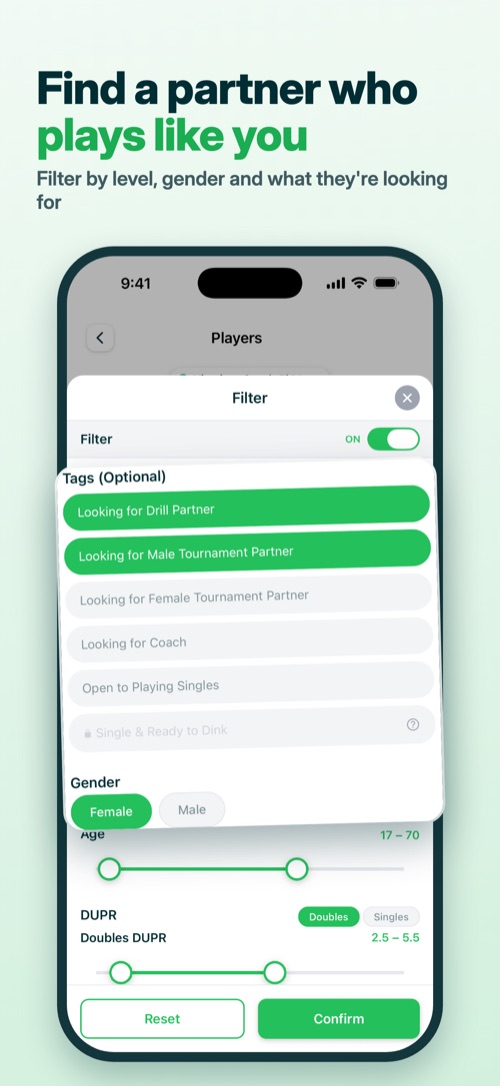
Every drill here needs a partner close to your level who wants reps, not a game. On InstaPickleball you can tag yourself Looking for Drill Partner, then filter the players near you by the same tag and by DUPR. Their profile shows when they usually play, so you can see whether your schedules overlap before you send a message.
The full walkthrough is in How to Find a Pickleball Drill Partner at Your Level.
Find someone to drill with
InstaPickleball is free on the App Store and Google Play.